Tuesday, 10 October 2017

Best value wines from Bordeaux

During the course of the year I taste many many wines. The most intense tasting time is at the beginning of April when I taste the barrel samples in Bordeaux. over the course of two weeks I might taste +- 1000 wines. Of course it is a great pleasure, but it can also be quite tough. Young Bordeaux wines, in particular, are packed with tannins and acidity, which does wonders for your teeth! Also barrel samples are in finished wines, or as Remi Edange (of Domaine de Chevalier) recently described them: 'When you taste barrel samples, it is like buying a part built house. You can see the potential. But the roof and windows have not been finished and the garden is a mess. But maybe in a couple of years it will all come together!'

But I also taste many mature wines during my work. On average at Bella Wine Tours I will taste 10-12 wines per day. Most of these are top Chateaux such as Lafite Rothschild, Margaux, Mouton Rothschild, Haut Brion, Clinet, Figeac and Yquem. Although it is an extremely pleasant way to spend your day, it is not actually what I drink on a regular basis. Here below are some of my recent value wines from Bordeaux.

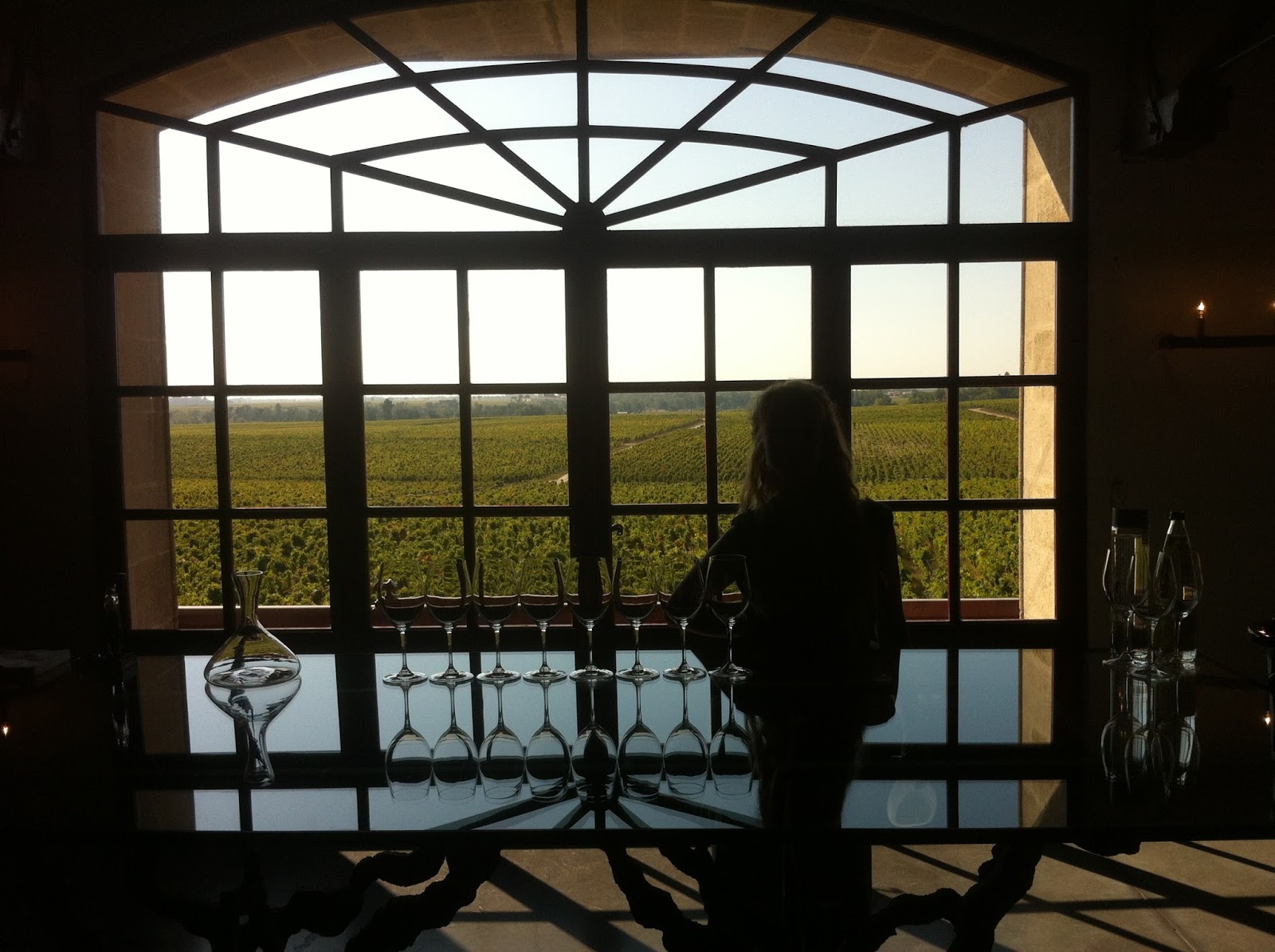
In the tasting room at Chateau Lafite Rothschild.
One of the most beautiful Chateaux in Bordeaux.


I have had a link and loyalty to Chateau de la Riviere in Fronsac for over 25 years. The soils are similar to Saint Emilion, the grapes are similar, but the prices are far less. For under €20 you can buy a mature vintage of Chateau de la Riviere. Also they have some large bottles available, which are fantastic for special anniverasies and parties. I bought my son a 15 litre (Nabuchodonosor) bottle from his birth year a couple of years ago.


A standard wine tasting in Bordeaux.
Barton family wines are always consistent
Chateau Leoville Barton was always considered one of the best value Cru Classe wines in the Medoc. Perhaps since 2005 it has become more in line with the other top Saint Julien estates, However it is worth looking out for Langoa Barton (I tasted their 2005 earlier this year in a blind tasting at Farr Vintners and it was exceptional). Also the Barton family have bought a Chateau in Moulis (further south in the Medoc and further inland). Chateau Mauvesin Barton is worth looking out for. The 2014, 2015 and 2016 will be excellent wines for mid term enjoyment. Unfortunately they have been hit heavily by the frost in 2017, so their production will be miniscule, if any.


Sometimes overlooked Chateau Brane Cantenac

It is quite easy to think of the Margaux appellation as Chateau Margaux, Palmer, Rauzan Segla, Giscours and Lascombes. However I adore Chateau d'Issan and Chateau Brane Cantenac as slightly old school quality wines. Both Chateaux have been in family ownership, by prominent Bordeaux families, for many years.....Brane Cantenac is owned by Lucien Lurton and d'Issan is part owned by Emmanuel Cruse.
Chateau Brane Cantenac 2005 and 2010 are exceptional wines.


Not classified, but great quality and value.

There were strong rumours throughout this Summer that Chateau Phelan Segur was up for sale.
I have always rated these wines. Especially the 2009 and 2010. Virtually next door to Chateau Montrose, but a fraction of the price.

A Sunday lunch value selection.

When a good friend, such as Chris Jones, comes for a proper Sunday lunch in Bordeaux, it is always worth trying out different wines. Having purchased our joint of beef (Rosbifs!!!), we browsed the wine selection in Carrefour Cauderan, Bordeaux.
These three wines above were all under €25.
Chateau Meyney has always been a favourite. Next door to Phelan Segur and Montrose. Outstanding value for a quality wine.
Chateau Clarke is the lesser known Rothschild estate in the Medoc. The high percentage of merlot is evident, and this wine is sublime.
Chateau Lespault-Martillac comes from the Bernard stable.....Domaine de Chevalier, Clos des Lunes, Domaine de la Solitude, Guiraud.
This wine from 2012 Pessac Leognan was an exceptional tight concentration of dark cassis and spice. A perfect value and quality wine.

Monday, 9 October 2017

Key Decisions running a wine estate


 So, you have bought a Chateau, Domaine, Quinta, Estate or Farm and you want to produce some exceptional wines.
The writing of the cheque for £$€ X million was painful enough. But you will probably need that money in reserve to upgrade the wine estate and improve the quality. The first investment (and most long term) is the most important......the vineyard. Are you happy with the vines planted on the specific soils? Do you need to replant some old vines? Is the density of planting correct? Are the soils vibrant with the specific level of micro organisms? Or are they compacted and dull? We often say that 80% of winemaking is from the vineyard.


The iconic Chateau Latour in Bordeaux. Francois Pinault bought this Chateau in 1993 for £86 million without visiting the estate. 
The terroir is a crucial aspect of any vineyard, and more particularly in France Appellations, as they are not allowed to irrigate. So the soils, as well as the inclination, altitude, subsoils, drainage, and location are all crucial.

Nature is also an irascible unknown that can effect your success or failure to run a wine estate. In fact nature is the most crucial aspect when you roll the dice.

Having a cellar full of wine is a luxury, but also a significant cost.
Having spoken recently to a well known gentleman in Pomerol, who owns a well respected estate, he mentioned three key decisions that he needs to make during the year that he can not go back on or change. Everything else should fall in to place if nature is kind and if the correct people are employed to do the work.

Harvest machines might be a lot less expensive than manual labour, but where is the romance?


The wine sits in expensive oak barrels (c€900 per barrel) for nearly 2 years before bottling. Cash tied up.
The three key decisions are:
1. The harvest date.........
This obvious decision is based on a large element of scientific analysis and also an element of wisdom and knowledge. It might be distracting if all your neighbours are in full harvest, when you are waiting for three extra important days for maximum maturity for your grapes. Or if there is a threat of rain in the coming days, do you try to pick the grapes as soon as possible or wait for the rain to pass and maybe have the problem of soggy, rotten grapes to pick. A key decision that can not be reversed.

2. The bottling and maturity........
There are many variables for ageing wine and ultimately deciding upon which style of wine you want in the market. A light fruity rose? A soft easy drinking red? A wine for long ageing and tight with tannins? Once the big decision to bottle the wine has been made, then you can not reverse that decision. A wine might taste fabulous in the tank or barrel, but it will change and metamorphosis once in the bottle.

3. Setting the market price..........
If you go too low, you will sell out too quickly. If you go too high, you might not sell at all.
Setting the correct market price for your wine will of course be based on your production costs and also your anticipated ROI. But also in Bordeaux you might need to consider the classification, or what other similar Chateaux are achieving for their wines. For Bordeaux wines, (which are mainly sold as futures) setting the price is a key decision that can not be reversed.

Many people buy wine estates with their heart rather than their head. Many aspects of nature can be a gentle roller coaster and hopefully a positive experience. However these three decisions above are the influence of humans in the wine making and selling process.

Wednesday, 4 October 2017

More innovation at Chateau Pontet Canet.

I have previously written about the innovations and developments of Chateau Pontet Canet.
However most of the work for biodynamic conversion has taken place in the vineyard.......special infusions sprayed on the vineyard, burying cow manure in cow horns, and generally using the lunar calendar for treatments and work in the vineyard. Then since 2012 the Chateau started to age their wines in unique amphora style cement tanks.
But now the focus of the team at Chateau Pontet Canet is turning to the winery and specifically fermentation. The picture above is of the new winery that has been opened in the last two weeks for receiving the 2017 grapes. 25% of the total production can go through fermentation here in special designed concrete tanks. The unusual aspect is that there is no electricity apart from the 12 volt LED lights. And the electricity generated to power their lights is generated from their own Geo Thermal bore holes, which have recently been dug on the estate. The idea is to eliminate any electro magnetism and influence on the wine. The tanks are designed on the prinicpal of 'the golden rule' and 'the magic number' (1.6180339887), which apparently is an important element of Leonardo da Vinci's architecture as well as Le Corbusier.


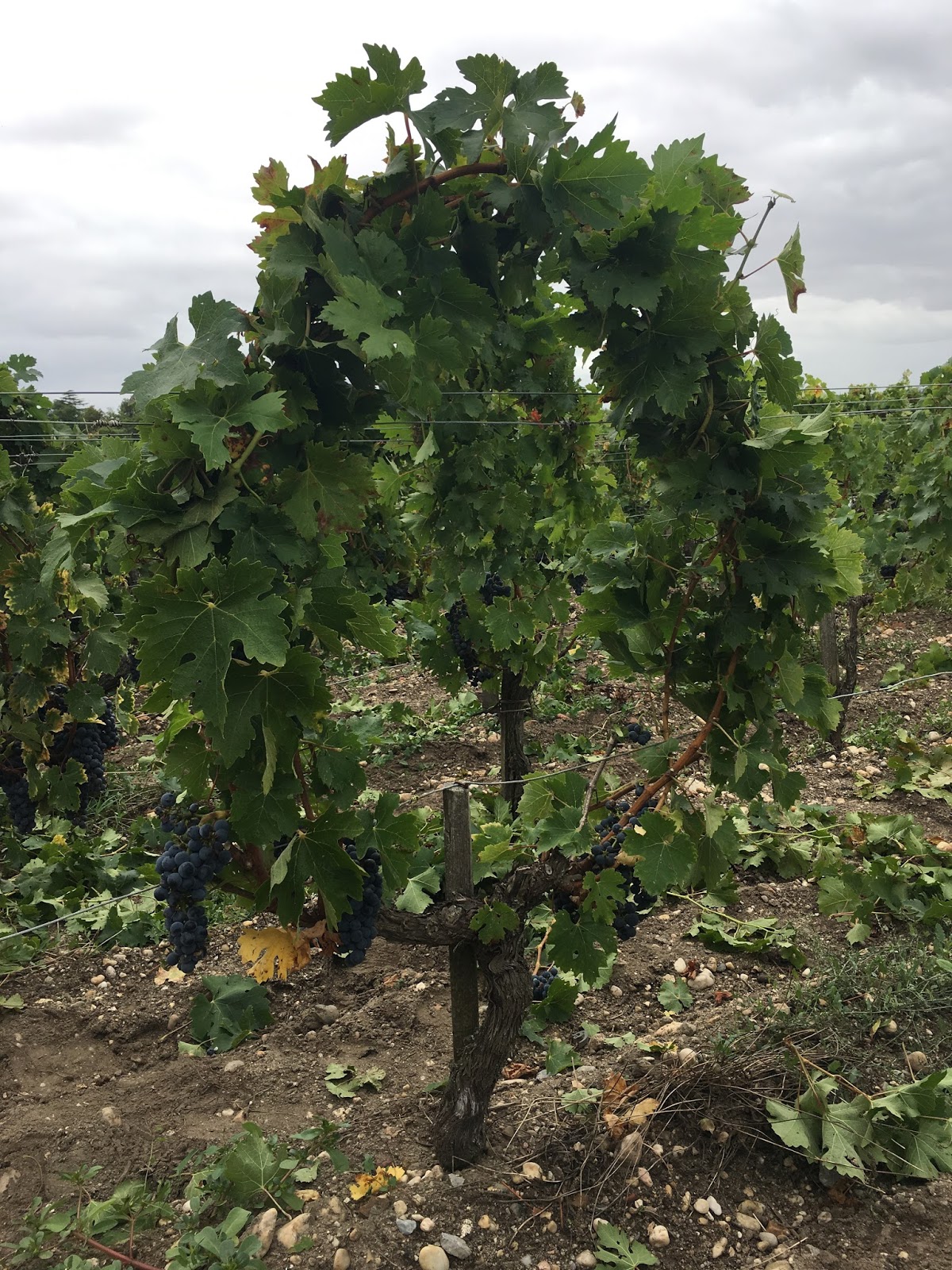
There has been much work in the vineyards at Pontet Canet. The vine above has not been trimmed. The shoots are tied to form an arch, which slows the growth and exposes the bunches of grapes.

 Forklift meets horse at the winery.

 The grapes arrive on the first floor of the winery at Chateau Pontet Canet, via horse drawn carts and then slightly more modern forklift trucks. The other unuusual element is that they are not using a classic de stemming machine. They are destemming the bunches by hand. The only other estate in Bordeaux who carries out this massively labour intensive action is Chateau Pape Clement in Pessac Leognan.


 The horses are being used more often at Chateau Pontet Canet. The latest construction has been the new stable block to cater for a few more horses. The eventual idea is to work all the vineyard with horses and also generate their own power and electricity via their Geo Thermal bore holes.
The Chateau was built in the late 18th Century, and has only had three family owners in the last three hundred years.....the Pontet family, the Cruse family and more recently (since 1975) the Tesseron family. But the innovations and changes over the last 15 years have been quite dramatic.

It will be fascinating to taste a vertical of Chateau Pontet Canet from 2000-2016 to judge all of the innovations and idiosyncracies coming from the constant innovations. Let's see what they do next......

Saturday, 26 November 2016

Chateau Pontet Canet. Innovation, enthusiasm and pioneers.

Chateau Pontet Canet built in 1781.

The original owner of the estate was Jean François de Pontet, who was Grand Ecuyer (Master of the Horse) for Louis XV at Versailles. Monsieur de Pontet became Governor of the Medoc and bought land near Pauillac in 1705 to plant vines. He expanded his vineyards by planting around the small hamlet of Canet and the Pontet Canet estate was established. This was common practise at the time to link your name to the place, eg Lynch Bages, Leoville Barton, Lafite Rothschild.
The estate flourished and the wines became very well known around the world. In fact they were so successful that they were included in the
1855 Classification of the wines of the Medoc. They were ranked 5th Growth, which was a prestigious honour.
The Chateau was bought in 1865 (soon after the 1855 classification) by the Danish/German wine merchant Herman Cruse, who also had other famous estates such as Giscours, Rauzan Segla and d'Issan in the Margaux appellation.  Herman Cruse had made his money by speculating and cornering the Bordeaux market in 1847. The Cruse family invested heavily in the Pontet Canet wine estate. They built the underground cellars as well as the main courtyard area and at the end of the 19th Century the architect and estate manager Theopole Skawinski built the very modern vat room in 1895. Skawinski was also the estate manager at Chateau Leoville Lascases and he designed the historic cellars at Chateau Lynch Bages. In fact the Delon family, who run Leoville Lascases are direct descendants of Skawinski. The 'chai' design is very similar to Chateau Lynch Bages with an upper reception and sorting area and then a gravity fed vat system.
Great to see the horses working at the Château


The Cruse family ran the estate up until the 1970s when they had a scandal. In 1973 they were found guilty of falsifying records in order to sell cheap table wine as more prestigious wine. They lost their reputation as merchants and they were forced to sell most of their estates.
In 1975 Guy Tesseron from the Tesseron Cognac house bought Chateau Pontet Canet. He ran the estate and then passed it on to two of his three children, Alfred and Gerard Tesseron. When Gerard Tesseron passed away, the stewardship of the Château became shared between Alfred Tesseron and Gerard's two daughters Melanie and Philippine.
So the Château has had three family owners over the last three hundred years. This is quite an achievement considering the peaks and troughs of financial stability as well as two World Wars.
Jean Michel Comme started working at the estate in 1989 and is now the Regisseur, looking after the vineyards and winemaking. Jean Michel is a deep thinking, innovative character who is passionate about his work. He has a small wine estate on the Right Bank, which he farms biodynamically. So, he convinced Alfred Tesseron to convert Château Pontet Canet to biodynamics in 2004. However there was a hiccup in 2007 when the pressure of mildew and disease in the vineyards required specific non organic spray treatments. This set back the biodynamic conversion, which was finally achieved in 2010.
The Château also introduced 3 horses to work on a trial basis over 8 hectares of vines in 2008, and this has now expanded to more horses and in fact now a complete stable development, so that 14 horses can operate over the whole estate.
Under Jean Michel Comme's stewardship and with the support of the Tesseron family the Château has significantly improved the quality of the wines.
I visited the estate last week and enjoyed a fascinating tasting of a few recent vintages with Jean Michel Comme:
2008.....Savoury, rich style with great purity of Cabernet fruit. Drinking well now, but will age for another 20 years no problem.
2011.....Slightly tight/closed at the moment, but with a core of dark fruit and good acidity. A balanced wine that definitely needs more time.
100 concrete amphorae in use since 2012 for ageing the wine.
2012....a fascinating wine, as this was the first vintage with 35% of the production being aged in large (900 litre) concrete amphorae. There is a significant change on the tannin structure and the wine is more fruity. It still has a concentration but seems very different and may not age quite as much.
2013.....much lighter style of wine and very reflective of the difficult year. There is more Burgundy character and much lighter mouthfeel. A wine for short term drinking.
2015....(a barrel/tank sample). Incredible intense rich hearty style and voluptuous tannins and silky smooth. A magnificent wine that should be on a par with the great 2009.

Innovation and Pioneers.....
For a Grand Cru Classe Chateau of 81 hectares to transform the whole production to biodynamic principles of viticulture is very innovative. It might be easier to work in Burgundy on a very small scale with biodynamics, but they are the first Medoc estate to farm biodynamically.

To reduce the amount of oak ageing for their wine is also a dramatic change to everyone else in their near viscinity. The philosophy links to searching for a purity of fruit, rather than masking the wine with expensive new oak, as well as preserving the oak forests.

I love visiting Château Pontet Canet and they are certainly one of the star estates in Bordeaux. They are not afraid to experiment with different practises like using horses or ageing their wine differently. I am sure that Jean Francois de Pontet would thoroughly approve of re introducing horses to the wine estate. Some of their neighbours in Pauillac have been slightly suspicious, but the truth is surely in tasting these great wines. I have personally bought several vintages of Pontet Canet for my cellar and will continue to follow their innovations.


In the tasting room at Pontet Canet
Manual sorting for the 2016 harvest.


Tuesday, 4 October 2016

Bordeaux Harvest 2016

The grape harvest is in full flow at the moment here in Bordeaux.
It is always an exciting, busy and quite nerve racking time for everyone involved in grape growing and wine production. The fruits of a year's work will soon be established. It will be a great relief as 2016 has not been the easiest growing season in France. There has been hail in parts of the Languedoc (near Montpellier) recently and Burgundy seems to have had all sorts of frost and hail in May....which is very late, which has severely effected the quantity and quality of grapes.
Cabernet Sauvignon grapes ripening at Chateau Lafite Rothschild


But Bordeaux is currently enjoying some lovely weather. We had a wet and damp April, May and early June and then a decent warm Summer. And early Autumn has been very warm with consistent high temperatures.


Manual sorting at Chateau Haut Bailly. What music are they listening to?
Grape bunches being manually sorted at Chateau Pontet Canet

The only negative for Bordeaux during the Summer has been the lack of water.....grape growers are never happy! But this Summer has been very dry, which has effected the foliage and photosynthesis on some of the younger vines. The older vines with more established roots on gravel soils seem to have flourished far better, as well as the older vines on the cooler limestone soils around Saint Emilion. Most of the merlot grapes have been picked already in the Medoc and the grapes seem quite small with thick skins. Perhaps a tannic concentrated wine for 2016.
The Cabernet Sauvignon and Cabernet Franc grapes are now being picked over the next two weeks. It is a delightful time to visit the Chateaux and smell the juice and see so much activity taking place. Bella Wine Tours continues to run some great tours throughout the year.
Biodynamic grapes gradually ripening at Chateau Pontet Canet


Saturday, 1 October 2016

White Wine in the Medoc?


Innovations at Chateau du Tertre in Margaux.
 Great to see some innovations and experiments at Chateau du Tertre. They have planted some Chardonnay, Gros Manseng, Viognier and Sauvignon Blanc to create their 'Tertre Blanc ' wine. Apart from Sauvignon Blanc these grape varieties are not permitted in the Bordeaux appellation to make Bordeaux Blanc. Therefore this white wine is declassified to 'Vin de France'.
They are also experimenting with large Austrian oak barrels, which is different from 99% of other top Chateaux, who use Allier or Troncais French oak. The only other Chateaux that I know who use a small amount of Austrian oak are Palmer (in Margaux) and Clinet (in Pomerol).
Tertre Blanc was first made in 2014 in small quantities (500 cases). It looks like 2016 could be a larger crop, but it will still be a small amount compared to the main emphasis at Chateau du Tertre on the red wines.
In the Medoc there are some interesting whites wines being produced, but they don't seem to be in the same quality league as Pessac Leognan. The major Chateaux that make white wines in the Medoc are: Palmer, Prieure Lichine, Talbot, Lynch Bages, Mouton Rothschild, Cos d'Estournel, Lagrange and Margaux.

 
The excellent guide, Anna, offering a lovely tasting of 2009, 2010 and 2011 Chateau du Tertre


Chateau du Tertre is certainly a wine estate to follow in the Margaux appellation for their improving quality. The Chateau was bought by Eric Albada Jelgersma in 1997 (he also owns nearby Giscours as well as Caiarossa in Tuscany). The talented Alexander van Beek looks after all Mr Albada Jelgersma's vineyards and since Frederique Ardouin arrived from Chateau Latour in 2008, the estate has been introducing biodynamic vineyard practises. The estate is also undergoing a re planting process to increase the density of vine plantings and to reduce the amount of Cabernet Franc on the vineyard.
The vines are planted over two main hills (Le Tertre means a 'hill' or 'mound') and the estate sits at the highest point of the Margaux appellation. The estate is ranked a 5th Growth from the classification of 1855, and interestingly it is the same size in 2016 as it was in 1855. There are very few estates that are the same size apart from Grand Puy Lacoste in Pauillac.
I recently tasted a magnificent 2005 Chateau du Tertre at the Chateau. It was perfectly 'in the zone' for tasting and drinking. Beautiful bright, balanced dark blackcurrant fruit style, with evident (but not too overbearing) acidity and tannin. A wine to enjoy now and over the next 10-15 years.
This wine retails for approximately £60 or $75 or €70.