 |
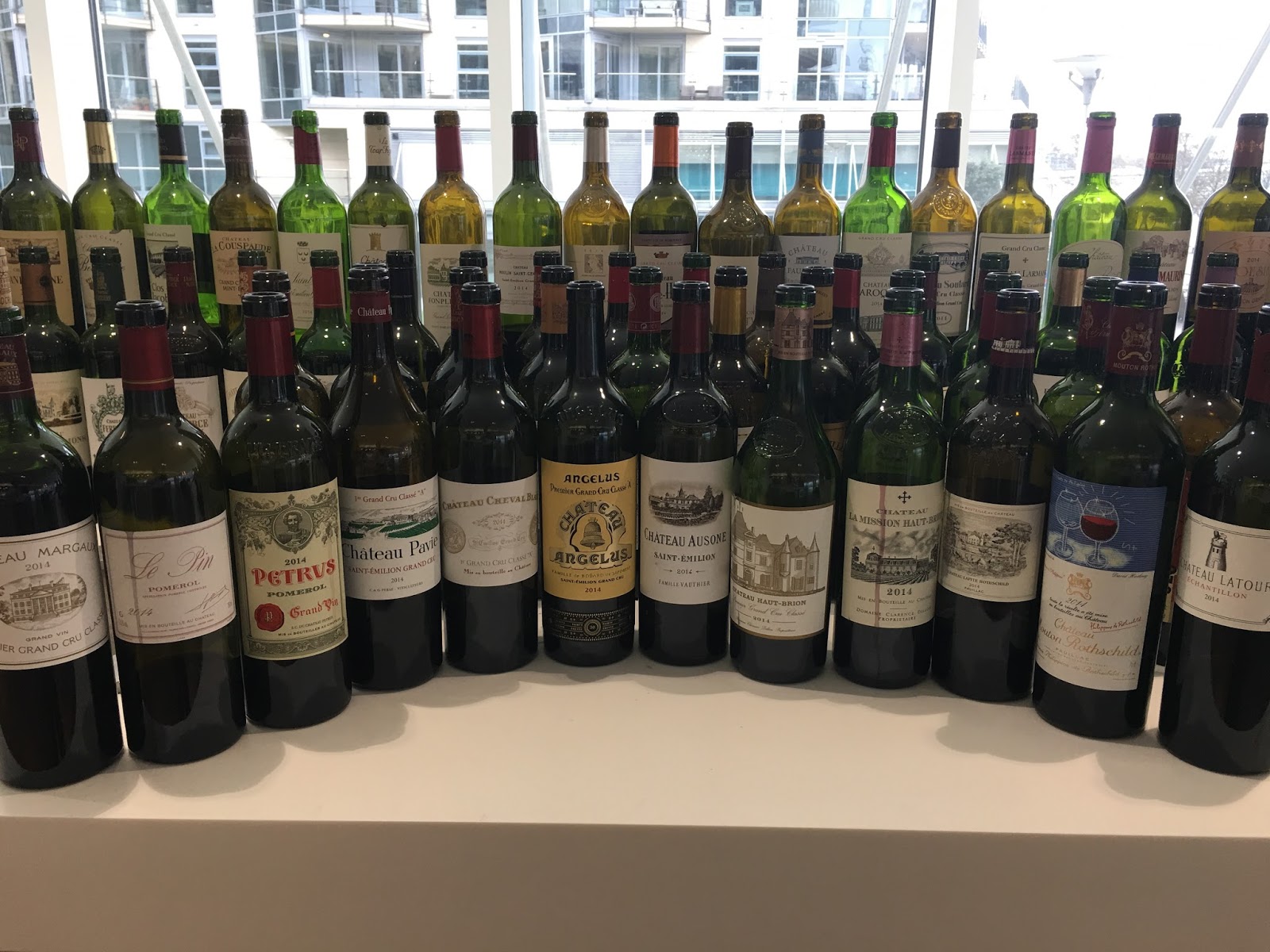
| Some delicious wines, but are they all 'Grand Cru'? |
Essentially there are three different interpretaions:
1. Grand Cru Classe de Graves means that the Chateau was classified in 1953 and then revised in 1959. There are no changes to the classification since then.The Chateaux were classified for red and white wines. There were originally 16 Chateaux in this classification which was drawn up by the INAO.....Institut National d'Appelation d'Origine.
Now there are 14 Chateaux in this classification as Chateau Laville Haut Brion and Latour Haut Brion have been purchased and included in the Haut Brion and La Mission Haut Brion estates.
 |
| Chateau Mouton Rothschild was controversially upgraded from 2nd Growth to 1st Growth in 1973. |
2. Grand Cru Classe de 1855 is probably the most widely recognised term for Grand Cru in Bordeaux. Napoleon 3rd asked for the 1855 classification to be prepared for the Universal Exhibition of Paris. The brokers and merchants of Bordeaux were instrumental in preparing the 1855 classification, and as these wine merchants were mainly trading on the Left bank of the river Gironde and Garonne, they only included wines on the Left Bank. So the red wines North of Bordeaux in the Medoc were mainly classified in 1855. There are 61 Chateaux in the Medoc that are Grand Cru Classe of 1855. In the Medoc there are currently 4 First Growth, 14 Second Growth, 14 Third Growth, 10 Fourth Growth and 18 Fifth Growth Chateaux. The only exception is Chateau Haut Brion (First Growth), which is in Pessac Leognan (a sub section of Graves). Interestingly Haut Brion is the only Chateau that is in the 1855 and Graves classification.
The 1855 classification is a guide and has been contentious over time. Not least due to the fact that there have been very few changes. Baron Philippe de Rothschild spent most of his life trying to up grade Mouton Rothschild from 2nd Growth to First Growth and he finally succeeded in 1973, when Jacques Chirac (then the Minister of Agriculture) signed the decree to upgrade the Chateau.
 |
| The majestic Chateau d'Yquem. Actually graded First Growth 'Superieur' in 1855. |
The other interesting fact is that there are 26 Sauternes Chateaux that are in the 1855 classification, as the sweet white wines were more popular than the red wines at that time, and had more potential to age. There are 26 First and Second Growth Chateaux in Barsac and Sauternes, with Chateau d'Yquem being the most prominent. In fact Yquem was considered a 'Premier Cru Superieur'.
3. Grand Cru Classe of Saint Emilion
Whilst the 1855 classification is the oldest and most well known, it only covered the Chateaux on the Left Bank of the Garonne and Gironde. So all the top estates of Saint Emilion, Pomerol, Fronsac, Castillon, Bourg and Blaye were not included in 1855.
So in 1955 the INAO (the government organisation, who control the Appellations) set out the Saint Emilion classification. The Saint Emilion appellation covers 5,400 hectares of vines (6% of the total of Bordeaux).
In 1955 there were 12 Chateaux classed as 'Premier Grand Cru Classé', two of which were recognised as being slightly superior, therefore they were given Class 'A' status.
Below the top 12 Chateaux there were 63 Chateaux graded as 'Grand Cru Classe' and then below that there were over 200 Chateaux rated as 'Grand Cru'. If a Chateau was not ranked within the classification, then the simple appellation of 'Saint Emilion' would appear on the label.
These were the original top rated Chateaux of Saint Emilion in 1955:
Premier Grand Cru Classe Class A
Ausone
Cheval Blanc
Premier Grand Cru Classe Class B
Angelus
Beausejour (Duffau Lagarrosse)
Beausejour Becot
Belair Monange
Canon
Clos Fourtet
Figeac
La Gaffeliere
Pavie
Trottevieille
But the major difference for the Saint Emilion classification set out in 1955 is that the INAO regularly review the status. In fact they reviewed the classification in 1969, 1986, 1996, 2006 and 2012. This seems much fairer than the set in stone 1855 classification. There is potential to invest in a Chateau and increase the quality and then to be fully recognised by an upgrade in the classification. However it has caused some major controversy, mostly when Chateaux are downgraded.
In 1986 Beausejour Becot was downgraded from Premier Grand Cru Classe to Grand Cru Classe. The reason given was that the owners (the Becot family) had increased the size of the vineyard and changed the character(and volume of production!) of the wine. This resulted in loss of reputation and loss of revenue, but the Becot family continued to make wine and established the fact that their wine was excellent quality and still achieved good scores and good prices in the market place. So, in 1996 Beausejour Becot was upgraded back to its original place as Premier Grand Cru Classe.
In 2006 the Bordeaux landscape was very different. Nowadays there is a significant amount of money invested in the top Chateaux. There are millionaires and billionaires investing in the top Chateaux of Bordeaux. The once humble farmers are now multi national businesses or luxury good firms such as Chanel, Prada, Gucci or Louis Vuitton. So there is a lot at stake!!
In the 2006 classification two Chateaux were very happy. Chateau Troplong Mondot and Chateau Pavie Macquin were promoted from Grand Cru Classe up to Premier Grand Cru Classe, whilst 11 Chateaux in the Grand Cru Classe section were demoted to Grand Cru status. Soon afterwards a group of 4 of these Chateaux went to court in order to overturn the ruling.
The main criticism was that the deciding jury consisted of wine merchants and Chateau owners, who had a significant conflict of interest for judging their peers' wines.
So the tedious legal battle erupted over the next 5 years. One moment the classification was annulled, the next moment it was back on the table. The two losers during this time were the consumer and the reputation of Saint Emilion.
In 2012 the INAO felt it necessary to re do the Saint Emilion classification. The legal arguments had swung back and forth. The new tasting panel would be made up of knowledgable wine people, but not attached to the area. So Burgundy, Rhone, Loire and Champagne experts were judging the Saint Emilion wines. Also Chateau owners and negotiants were not judging their own wines and their neighbours!!
The criteria for grading was also clarified.
For Premier Grand Cru Classe wines the following elements were judged:
30% was based on a tasting of the last 15 years of the estate.(and 20 years for Class A)
35% was based on market reputation.
30% was based on the terroir.
5% was the estate and practices.
For Grand Cru Classe wines there was a slightly different criteria (I do not know why!!)
50% was based on a tasting of the last 10 years of the estate.
20% was based on market reputation.
20% was based on the terroir.
10% was the estate and practices.
Clearly this is quite confusing. Why not have the same criteria for all wines? Also the tasting element should be a far higher percentage of the overall decision.
So in 2012 the new Saint Emilion classification was announced.
Many Chateaux were upgraded and few were downgraded. Clearly the authorities did not want to be back in court.
The current Saint Emilion classification is:
Premier Grand Cru Classe Class A
Ausone
Cheval Blanc
Angelus (NEW upgrade)
Pavie (NEW upgrade)
Premier Grand Cru Classe Class B
Beausejour (Duffau Lagarrosse)
Beausejour Becot
Belair Monange
Canon
Canon la Gaffeliere (NEW upgrade)
Clos Fourtet
Figeac
La Gaffeliere
Larcis Ducasse (NEW upgrade)
La Mondotte (NEW upgrade)
Pavie Macquin
Troplong Mondot
Trottevieille
Valandraud (NEW upgrade)
And below this there are now 63 Grand Cu Classe Chateaux.
So, I hope this article has clarified the three main classifications of Bordeaux:
Grand Cru Classe de Graves
Grand Cru Classe de 1855
Grand Cru Classe de Saint Emilion.
It is not a perfect system as the three classifications only cover a part of the Bordeaux vineyards. There are many excellent Chateaux that have no classification. For example there are some great Cru Bourgeois Chateaux in the Medoc such as Sociando Mallet, Phelan Segur, Meyney and Chasse Spleen that are not included in the 1855 classification.
Also the great quality appelation of Pomerol has no Grand Cru system. So Petrus, Le Pin, L'Evangile, Gazin, Vieux Chateau Certan, Trotanoy and La Fleur do not have any classification.
At least the Saint Emilion classification is reviewed and upgraded, which means that if you buy a Chateau in the area and invest in the vineyards, the winery and significantly increase the quality, you can be recognised. But with the legal issues and court problems in the last 13 years, there could be a few fireworks for the 2022 Saint Emilion classification. Will Canon and Figeac move from Premier Grand Cru Classe B to A??? Let's wait and see.
The other ridiculous thing is that we are still referring to the 1855 classification. How many businesses in 2019 refer to a grading system that was set out 164 years ago??
It is not perfect but is a historical reference point.
Who would feature in a new classification of the Medoc? Who would disapear?
In fact I will be writing my own classification shortly, based purely on tasting.


